
In 2026, the data centers that win are not simply the ones that secure the most megawatts. They are the ones that waste the fewest. AI workloads are pushing rack densities and energy bills to levels the industry has never handled, and the grid cannot always keep up. That has turned efficiency from a sustainability talking point into a core design requirement.
The numbers explain why. Gartner estimates global data center electricity use will rise about 26% this year, from roughly 447 TWh in 2025 to 565 TWh, with AI-optimized servers alone nearly doubling their draw. The IEA expects data center consumption to approach 950 TWh by 2030. Meanwhile, the Uptime Institute’s 2026 Global Data Center Survey found that nearly two-thirds of operators are running into limits on available power, and almost four in five are worried about rising costs.
Efficiency gains have not kept pace on their own. Uptime’s survey puts the industry’s average PUE (power usage effectiveness) at 1.52, a figure that has hovered near 1.5 for years. Newer, larger facilities do much better: weighted by capacity, the average drops to 1.36. The gap between those two numbers is where the opportunity lies.
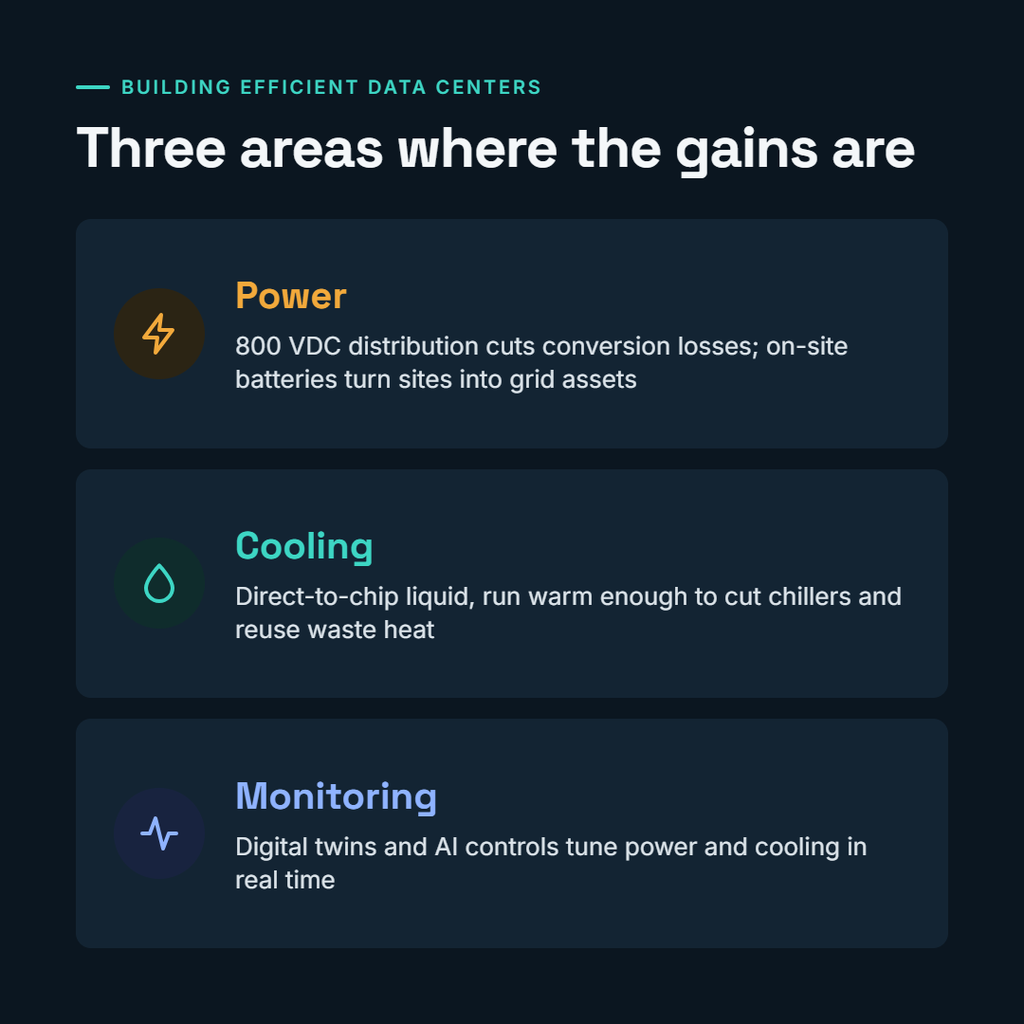
Below are the tactics shaping how new data centers are being designed and built, across the three areas that matter most: power, cooling and monitoring.
Power: fewer conversions, smarter storage
The biggest change in power design is a move toward high-voltage direct current. Traditional facilities convert power between AC and DC several times between the utility and the chip. Every conversion loses energy as heat, which then has to be cooled away.
800 VDC moves from concept to deployment
NVIDIA, Google and Microsoft have been developing an 800-volt DC architecture through the Open Compute Project. They published a joint white paper in March 2026 and a solid-state transformer specification in July, and more than 80 equipment and infrastructure companies now back the effort, including ABB, Eaton, Schneider Electric, Siemens and Vertiv.
The benefits stack up quickly:
- Lower losses. ABB’s research suggests a DC-based architecture can cut total energy costs by about 9%. At gigawatt scale, that is a material number.
- Fewer conversion stages. Texas Instruments has demonstrated a design that needs only two steps from 800 V down to processor power, with a bus converter reaching 97.6% peak efficiency.
- Less copper. Higher voltage moves the same power through smaller conductors. One estimate suggests rack busbars in a 1 GW facility at today’s lower voltages could need up to half a million tons of copper.
- Less heat in the rack. Removing AC/DC power supplies from inside IT racks also removes a source of heat, lowering cooling load.
Adoption is designed to be gradual. NVIDIA’s 800 VDC power rack, arriving in the second half of 2026, is meant to slot into existing facilities. A row-level power center using an overhead 800 VDC busway, supporting up to 2 MW per row, is expected in 2027. For greenfield sites, facility-scale DC power blocks will convert medium-voltage grid power to 800 VDC in a single step.
Batteries become grid assets, not just backup
The second power trend is about getting connected at all. In many markets, the wait for new utility capacity runs to years. Operators are responding with on-site battery energy storage systems (BESS) that can discharge when the grid is stressed, so the facility’s draw drops while servers keep running.
Aligned Data Centers is using this approach at its Hillsboro, Oregon campus with Calibrant Energy. The battery system acts as a grid-responsive asset, allowing the site to come online years ahead of conventional utility upgrade timelines. In Europe, analysts estimate that if data centers offered just 30 hours of flexibility a year, they could more than double the grid capacity available to them.
Takeaway for new builds: design the electrical path with DC in mind, even if you start on AC, and treat storage as a tool for grid access and cost control, not only as UPS backup.
Cooling: liquid goes mainstream, and runs warmer
Cooling is changing faster than at any time in the past decade. Air alone cannot remove the heat from today’s densest AI racks, so liquid cooling is moving from niche to standard practice.
Direct-to-chip leads the way
Cold plates mounted directly on GPUs and CPUs are the most common approach, used in an estimated 40% to 50% of liquid-cooled facilities. Hardware makers now ship liquid-ready servers with built-in cold plates, and new AI-focused designs integrate direct liquid cooling from day one rather than retrofitting it later.
Market forecasts vary, but they agree on the direction. Most analysts value the liquid cooling market at roughly $4 billion to $6 billion today, growing at around 18% to 20% a year. Coolant distribution units (CDUs), the pumps and heat exchangers that move fluid between facility and rack, are one of the fastest-growing pieces.
Hybrid is the real standard
Liquid cooling does not mean the end of air. Most facilities will run hybrid designs, using liquid for the hottest components and air for storage, networking and residual heat. Immersion cooling, where servers sit in a dielectric fluid, is growing too, especially for specialty and edge deployments. The design goal is flexibility: a thermal system that can absorb future density increases without a rebuild.
Warmer water, fewer chillers
The most important efficiency tactic in cooling is counterintuitive: run the liquid warmer. Modern chips tolerate higher coolant temperatures, so facilities can supply water at around 75°F (24°C) or more. At those temperatures, dry coolers and outside air can reject heat for most or all of the year, and mechanical chillers, one of the largest energy users in a traditional facility, can be reduced or eliminated.
Waste heat becomes a product
Warmer return water also makes heat reuse practical. Research presented at the 2026 ACEEE Summer Study described a chiller-less design with warm-water liquid cooling and heat reuse achieving an energy reuse effectiveness (ERE) below 1.0, meaning more energy was put to use than the facility’s overhead consumed. At TU Darmstadt in Germany, a hot-water-cooled computing center supplies 45°C (113°F) heat to the campus, reusing 20% to 50% of its waste heat depending on the season. Heat pumps can boost lower-grade heat for district heating networks.
Takeaway for new builds: plan for liquid from the start, size for density growth, and set coolant temperatures as high as your hardware allows. Then look for a neighbor who can use the heat.
Monitoring: from dashboards to digital twins
You cannot optimize what you cannot see. As power and cooling systems grow more complex, monitoring is shifting from periodic reports to continuous, predictive control.
Digital twins move into design and operations
A digital twin is a live virtual model of a facility, fed by sensors across power, cooling and IT equipment. During design, it lets engineers test layouts and airflow before anything is built. In operation, it shows how every component is performing and lets managers simulate changes, such as adding GPUs or introducing liquid cooling, before touching the live environment. Schneider Electric, Siemens, Vertiv, NVIDIA and others now offer platforms in this space, and SaaS-based DCIM (data center infrastructure management) tools are putting these capabilities within reach of smaller operators.
Denser sensing, AI-driven control
The next layer is AI that acts on the data. Dense networks of temperature sensors, thermal cameras and smart valves feed models that adjust fan speeds, pump rates and setpoints in real time, reducing the energy wasted on overcooling. More advanced systems schedule flexible workloads to follow renewable energy availability and learn seasonal patterns over time.
Operators are adopting this carefully. Uptime’s 2026 survey found expectations for AI in operations cooled slightly this year, with trust highest in lower-risk uses such as sensor analytics and predictive maintenance. That is a sensible starting point: let AI recommend, prove it out, then give it more control.
Measuring more than PUE
PUE remains the headline metric, but it only shows overhead relative to IT load. Leading operators now track a wider set:
- WUE (water usage effectiveness), as water scarcity draws scrutiny
- CUE (carbon usage effectiveness), tying energy to emissions
- ERE (energy reuse effectiveness), crediting heat that is put to use
- Compute utilization, since an idle GPU at a perfect PUE is still waste
Takeaway for new builds: build the sensor network and data platform into the design, not as an afterthought, and pick metrics that reflect your real goals.
The bottom line
Power, cooling and monitoring used to be designed by separate teams. The most efficient new facilities treat them as one system. High-voltage DC reduces the heat that cooling must remove. Warm-water liquid cooling cuts chiller energy and creates heat worth selling. Digital twins and AI tie it together, testing each change before it is made and tuning the facility every minute after.
For anyone planning a new build or a major upgrade, the questions to ask early are:
- Can our electrical design move to 800 VDC as rack densities rise?
- Can on-site storage speed up our grid connection or lower our costs?
- Is our cooling plant designed for liquid, and for the warmest water our hardware accepts?
- Is there a nearby user for our waste heat?
- Will our monitoring platform let us model changes before we make them?
The facilities that answer these questions at the design stage will be the ones that do more with every watt.
Planning a new build or upgrade? Explore our data center infrastructure solutions in Atlanta and critical power solutions.
Sources
- Uptime Institute Global Data Center Survey 2026
- Uptime Institute: The growing PUE advantage of larger data centers
- Corriere Comunicazioni: Uptime 2026 survey findings on cost and power constraints
- Gartner figures via Ecosistema Startup
- OnMSFT: NVIDIA plans first 800 VDC platforms (incl. IEA estimates)
- NVIDIA: Why scaling AI compute requires a new power architecture
- Texas Instruments 800 VDC power architecture announcement
- Data Centre Magazine, June 2026: The case for 800V DC (ABB)
- Folio3: Mitsubishi Electric joins push for 800 VDC
- Macquarie: Aligned and Calibrant on-site battery storage
- Hive Power: Data centre flexibility and grid access
- CoolIT Systems: Data center cooling trends to watch in 2026
- P&S Intelligence: Data center liquid cooling market
- Global Market Insights: Data center liquid cooling market
- Data Center Frontier: Cooling from the valve up
- ACEEE 2026: High-temperature liquid cooling and heat reuse
- TU Darmstadt: Waste heat utilization of hot-water-cooled data centers
- Upsite: How digital twins and AI will impact data centers and DCIM
- arXiv: A unified DCIM framework for AI data centers